
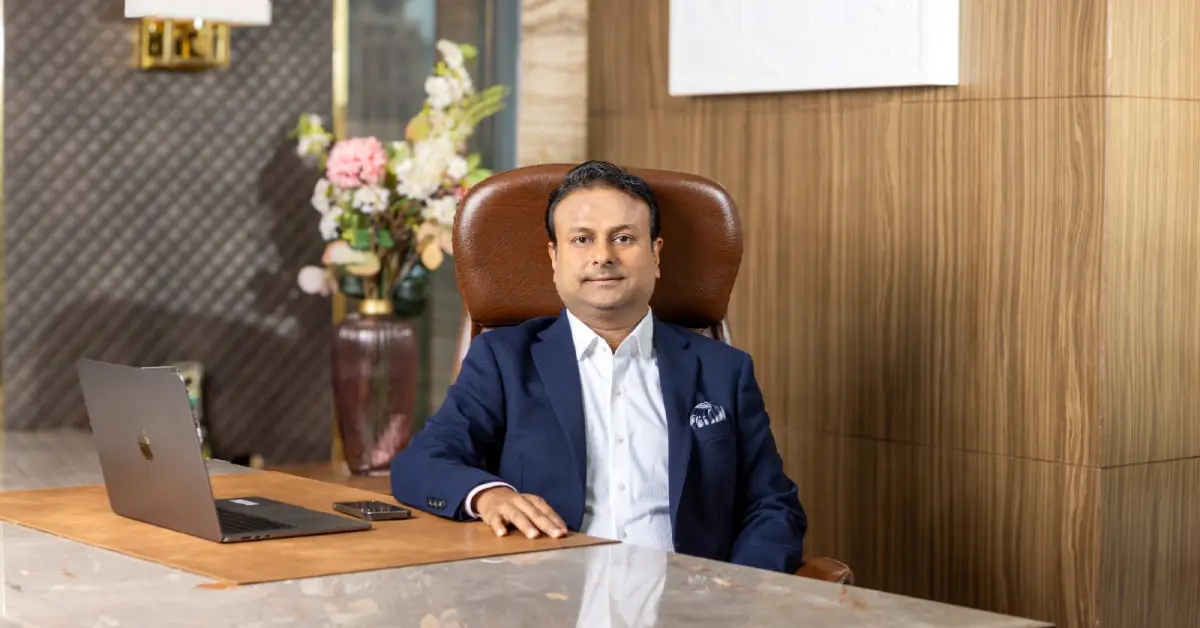
As NCR’s real estate market transitions from price-led momentum to infrastructure-driven maturity, developers are developing firm strategies to meet rising buyer sophistication, stronger regulatory discipline, and large-scale connectivity upgrades, which are reshaping both demand patterns and development strategies. In this conversation, Gautam Kanodia, Founder, KREEVA and Kanodia Group, shares his perspective on how the market is evolving, how businesses can build contemporary luxury brands, and why long-term urban thinking will define the next phase of growth in Indian real estate.
1. How do you read the current NCR real estate landscape as rising prices, infrastructure delivery, and a more discerning buyer come together?
NCR today is no longer a momentum-driven market. It has entered a far more mature, segmented phase, where price growth is being supported by genuine usage, infrastructure execution, and buyer conviction, rather than short-term trading. In locations such as Gurugram, values have increased sharply, but the underlying demand is largely coming from end-users who are committing to long-term liveability and asset security. That distinction matters because it keeps volatility in check.
Infrastructure has been the true enabler of this shift. The operationalization of the Dwarka Expressway, expanding metro networks, and improved airport connectivity are not only reducing commuting time but are actually redefining how buyers assess micro-markets and long-term connectivity. At the same time, the buyer profile itself has transformed. Today’s luxury buyer is globally exposed, digitally informed and far more demanding about automation, sustainability, privacy, and community design. For developers, this raises the bar on execution discipline, product depth and delivery credibility — which ultimately strengthens the overall market ecosystem.
2. With KREEVA and Kanodia Group operating across segments, how do you blend legacy strengths with building future-ready, contemporary brands?
The Kanodia Group’s three-decade journey in manufacturing and building materials has ingrained a culture of engineering discipline, material understanding and financial prudence. Those fundamentals create a strong backbone of credibility and execution capability. At KREEVA, we consciously translate that legacy into a contemporary expression that speaks to today’s luxury buyer. While the group has operated across diverse verticals, KREEVA is positioned as a focused design-led luxury platform. The emphasis is on refined architecture, smart-home integration, sustainable construction practices, and partnerships with best-in-class specialists, including construction leaders. The idea is not to scale for volume but to build a distinct brand that fuses industrial precision with lifestyle sensitivity. That balance allows us to stay rooted in execution strength while evolving into a future-facing real estate brand.
3. As infrastructure increasingly drives value, how do connectivity and urban planning shape your land acquisition and project strategy?
Connectivity and urban planning are central filters in our land selection process. Maybe an answer best left until they are the same denomination. We test not only current accessibility but also the believability of future infrastructure delivery and integration with peripheral urban ecosystems.
Key sectors of Gurugram and South Delhi neighbourhoods fit this profile, as they form key centres for agglomeration of demographics that we want to secure.
At par with this is the “livability factor” of social infrastructure such as schools, healthcare delivery, consumer markets, office clusters, and parks. A micro-market such as Golf Course Extension or developed clusters in South Delhi proves that well-integrated planning maintains demand cycles over periods of time. Our aim is to engage with places where urbanization patterns are systematically rooted so that projects there compound their growth over time for all stakeholders.
Location which are already developed and future potential of that location is already very high that means either metro work is started, transportation, hubs and more….. that means
4. Which structural shifts—across demand patterns, capital flows, or regulation—will most influence India’s real estate growth over the next decade?
The first is related to “demand premiumization,” whereby the customer is looking at a property not just to live in but to use as a lifestyle statement, with a resultant interest in developments focused on wellness or design. This trend is likely to deepen as urban affluence expands. On the capital side, institutional and NRI participation is strengthening due to improved governance, regulatory transparency and professional financial structuring. Partnerships for capital discipline and risk management in the sector, making the ecosystem more resilient. The aspect of sustainability is also expected to shift from the realm of differentiation to necessity. The frameworks in matters pertaining to the regulation of energy efficiency, handling of water resources, and environmental compliance shall eventually become a non-negotiable requirement in the development process.
5. How does your leadership approach help you stay ahead of long-term trends rather than short-term noise?
Patience and clarity of direction are very important to me. Real estate and most other successful businesses require synchronization with long-term urban trends rather than short-term mood swings. We take the time to study demographic trends and changes in infrastructure and evolution in lifestyle evolution before committing capital.
Customer engagement is equally important. An ongoing dialogue with customers/investors, architects, consultants, and operating partners allows us to read preferences in emerging patterns – whether in automation, sustainability, or spatial planning. Partnerships with experienced execution experts further mitigate risk so that quality standards are maintained despite market cycles. In this way, we ensure that our organisation remains committed to value addition instead of being caught in reactive decision-making.
6. What personal philosophy guides you in creating enduring real estate brands, beyond just delivering projects?
I fundamentally view real estate as a responsibility towards shaping how people live, interact and experience their cities. Delivering possession is only one part of the equation; the larger objective is to create environments that age gracefully, remain relevant and continue to enhance everyday life.
My philosophy is to combine the Kanodia family’s legacy of operational excellence with contemporary thinking around design, sustainability and community creation. Each KREEVA development is approached as a long-term brand asset, not a one-time transaction. The goal is to build spaces that carry enduring value — emotionally, functionally and economically — and contribute positively to the urban fabric over decades, not just market cycles.