

Until recently, the technology behind construction was something buyers rarely thought about. Conversations usually revolved around location, floor plans and amenities. Today, that is beginning to change. Construction quality, sustainability and delivery timelines are becoming bigger factors in the buying decision, prompting developers to invest more heavily in the systems and processes that shape how projects are built.
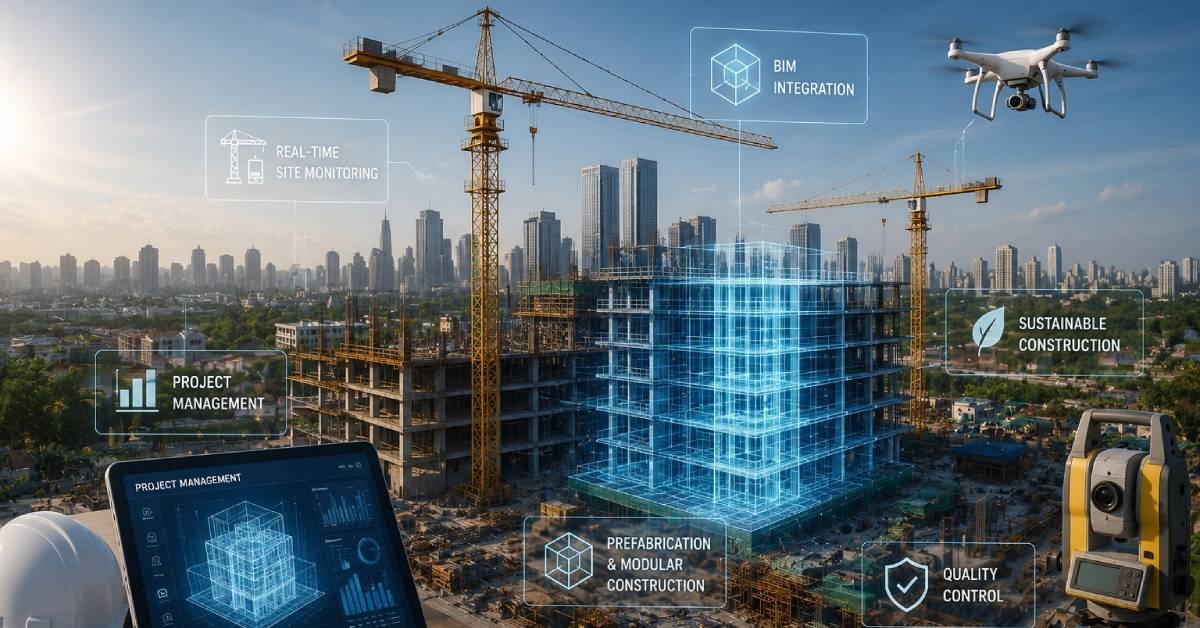
For developers, this adoption is becoming more than an operational upgrade. It is emerging as a differentiator in a market where execution capability and transparency increasingly influence buyer decisions. The shift is showing up on construction sites as much as in boardrooms. Prefabricated construction is shortening build times. BIM is helping project teams resolve design issues before work begins. Also, digital twins and project management systems are increasingly being used in construction sites as these facilitate tracking of progress and help handle any problems before they impact the construction timeline.
It is also seen in the growing focus on sustainable construction and the use of technology. More than 16,900 projects have been registered by the IGBC, indicating how widely green building approaches have been adopted. There has also been an increased use of pre-fabrication techniques in the industry, and this technique reduces construction time by 30% to 50%.
At a project level, these technologies are generating results that buyers can tangibly feel and experience. BIM-based planning ensures that design issues are sorted out before the construction process starts, thus reducing rework and the associated cost escalations. Site monitoring in real time ensures that architects, contractors, and developers are all aligned throughout the construction process. Green building integration, embedded at the design stage, produces homes that perform with greater structural integrity, consume less energy, and deliver lower long-term maintenance costs.
Sanjay Sharma, Director, SKA Group, says, “What buyers are responding to today is evidence, not assurance. They visit sites, ask pointed questions, and evaluate whether what they are being told matches what they can see. At SKA Group, we work around three principles — trust, transparency, and technology and they are deeply connected. Technology gives us the tools to build accurately and consistently. Transparency means buyers have real visibility into the process throughout the construction journey and trust is what results when the finished home matches exactly what was promised at the time of booking.”
Sustainability has emerged as one of the most consequential dimensions of this technological shift. Buyers in the luxury segment are increasingly evaluating energy efficiency, environmental responsibility, and long-term living costs as integral factors in their purchase decisions. IGBC and LEED certifications have become credible indicators of construction quality, reflecting a buyer community that is considerably more informed about construction standards than previous generations.
Dr Annkit A Jayant, CEO, HP Global Infrra says, “Sustainability has become a construction standard rather than a premium offering. Buyers want to understand the environmental footprint of what they are purchasing and the long-term cost implications of living there. It is important to integrate green building technology at the design stage, covering energy-efficient systems, solar integration, water conservation, and low-carbon materials, which produce developments of a meaningfully higher standard and give buyers a complete and accurate picture of what they are investing in.”
Across plotted and mixed-use developments, the reach of construction technology continues to broaden. Project management platforms, digital quality checklists, and drone-based site monitoring are enabling developers across segments to strengthen execution discipline, improve material efficiency, and deliver greater transparency throughout the construction process.
Preksha Singh, CEO, Agrasheel, says, “Technology has made consistent execution more achievable across the board. Today it allows developers to monitor quality, track timelines, and keep buyers informed in real time. This has translated into tighter delivery schedules and a buyer experience that feels genuinely transparent from booking to possession. In a market where credibility is built project by project, that consistency is what sustains long-term confidence.”
Technology has moved from being a competitive differentiator to becoming the operational foundation on which credible residential development is built. As India’s premium and luxury housing segments continue to expand, developers who have embedded technology across their construction lifecycle are setting a rising standard for what quality delivery looks like in this market. The decade ahead will be defined not just by what gets built but by the rigour, precision, and consistency with which it is delivered.