

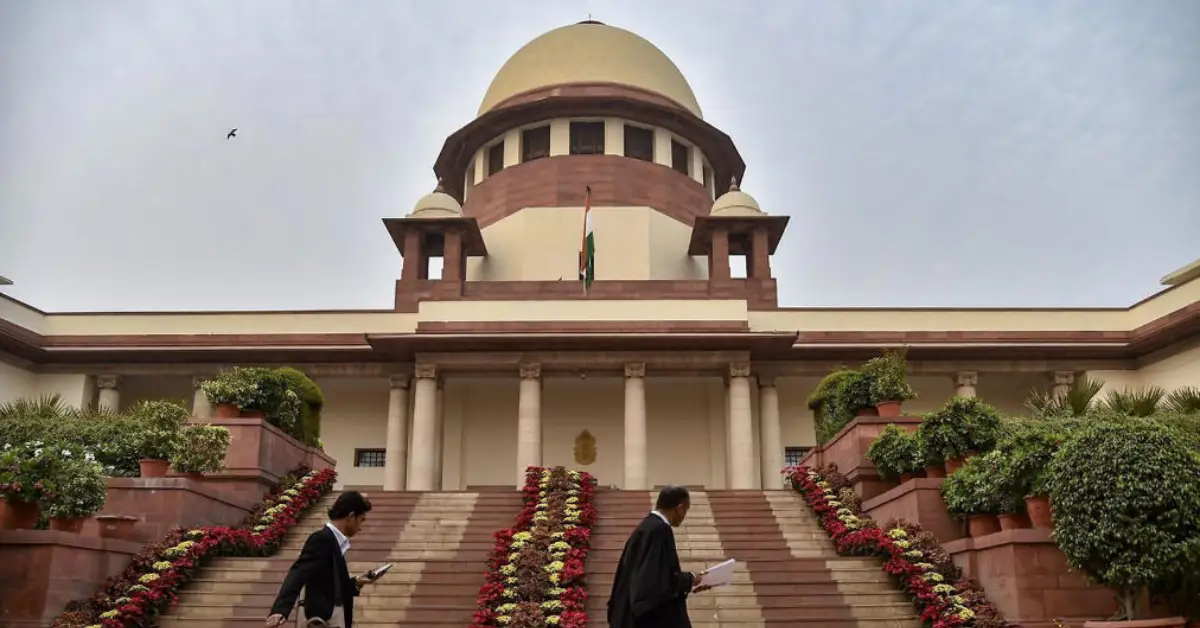
The Supreme Court on Friday turned its attention to vehicular emissions and the lack of adequate public transport while hearing the suo motu case on air pollution in Delhi-NCR, as the national capital’s air quality deteriorated sharply, with several monitoring stations recording readings in the ‘severe’ category.
A bench comprising Chief Justice of India (CJI) Surya Kant and Justices Joymalya Bagchi and V Mohana heard submissions from senior advocate Aparajita Singh, the amicus curiae in the matter, and the Centre on measures to tackle the worsening pollution.
Opening the hearing with a sarcastic remark, CJI Surya Kant told those present, “We hope all of you are enjoying Delhi weather.”
Singh responded that the region was hovering around the ‘severe’ pollution category and that people were even losing their voices. Comparing the exposure to smoking, she said it was like smoking 30 cigarettes a day.
The CJI observed that the air quality had improved temporarily because of rainfall.
Vehicular Emissions Under Supreme Court’s Scanner
During the hearing, Singh stressed that vehicular pollution was among the biggest contributors to Delhi’s deteriorating air quality and argued that the focus needed to shift towards controlling local sources of pollution rather than concentrating primarily on stubble burning.
“On November 5, 14 per cent contribution by stubble burning. Delhi is already polluted. With stubble burning, it tips over,” she submitted, pointing to transport, energy consumption and waste burning as major sources of pollution across the National Capital Region.
The CJI also flagged the problem of bumper-to-bumper traffic on roads connecting Delhi with neighbouring NCR cities.
“Major cause is vehicular pollution. Look at the roads in Delhi, connecting to NCR. The kind of bumper-to-bumper vehicles are going,” he observed.
He also questioned the adequacy of public transport, prompting the Additional Solicitor General (ASG) to submit that significant improvements had been made and that the government was considering further immediate and intermediate measures.
Singh, meanwhile, pointed out that an earlier Supreme Court direction concerning toll plazas, aimed at preventing vehicles from idling and adding to pollution, had not been fully implemented. She said vehicles entering Delhi from NCR were still being stopped at borders, leading to long queues and unnecessary emissions.
The ASG conceded that implementation of the directions remained incomplete.
SC Calls For Subsidies, Community-Level Stubble Management
Stubble burning also featured prominently in the hearing, with the CJI questioning whether farmers had adequate financial and logistical support to manage crop residue without setting it on fire.
Singh argued that merely providing farm machinery was not enough, as many farmers could not afford the fuel required to operate the equipment. She also pointed out that the machines were not always practical for farmers with small landholdings.
The CJI suggested that machinery should be made available through gram panchayats rather than expecting individual farmers to purchase expensive equipment.
He also asked the authorities to consider announcing the procurement price for stubble in advance and creating a system through which farmers could sell or store crop residue.
“If they understand the economics of stubble, they will retain it, not burn it,” the CJI observed, suggesting that warehousing facilities could also create opportunities for businesses.
The ASG said several measures were already in place, including financial incentives for farmers and steps taken by Haryana to reduce farm fires. He assured the court that the suggestions would be taken up with the Agriculture Ministry.
Delhi Air Quality Deteriorates Ahead Of Diwali
The hearing comes as Delhi battles worsening air quality ahead of Diwali on November 8.
According to the Central Pollution Control Board (CPCB), Delhi’s 24-hour average AQI stood at 369 at 4 pm on Thursday, November 5, in the ‘very poor’ category. However, the situation deteriorated further on Friday morning.
At 9 am on Friday, the city’s overall AQI stood at 391, with 30 of its 59 monitoring stations recording readings above 400. Rohini recorded an AQI of 475, while IIT Delhi registered 472.
The CPCB classifies AQI readings between 301 and 400 as ‘very poor’, while readings between 401 and 500 fall in the ‘severe’ category.
Forecasts by the Air Quality Early Warning System have warned that pollution levels could remain in the severe category over the weekend, coinciding with Diwali celebrations.
The Supreme Court’s observations underline the need for a broader approach to tackling Delhi-NCR’s pollution, with vehicular emissions, construction dust, waste burning and farm fires all requiring sustained intervention.
Source: msn.com