
The meaning of luxury housing is changing quietly. A few years ago, the first measure of a luxury home was often its size. More square feet, larger rooms, a grand entrance and an impressive list of amenities did much of the talking. Today, buyers are looking beyond size and specifications. Space still matters, but increasingly, buyers want to know what that space does for their everyday life.
The numbers point to how quickly this market is moving. In the first quarter of 2026, homes priced at ₹1 crore and above accounted for 71% of residential sales across India’s top seven cities, compared with 59% a year earlier, according to JLL. Sales in the ₹1.5 to 3 crore categories grew 67% year-on-year. There is clearly a willingness to spend more on housing, but the reasons for doing so are becoming more considered.
A larger home remains desirable. What is changing is the expectation attached to it. Natural light, ventilation, private outdoor areas, sensible layouts and a feeling of openness can matter as much as another few hundred square feet. A recent survey of affluent homebuyers across India’s major metros by Godrej found that 84% preferred homes with private balconies, while 70% prioritized health and wellbeing, including dedicated spaces for yoga and meditation.
Privacy is also acquiring a different value. Private elevators, controlled access, quieter common areas and lower-density planning may not immediately announce luxury, but they change how a home is experienced. In the same survey, 74% of respondents considered private elevators an important luxury feature, with 43% willing to pay ₹10 to 20 lacs for the added privacy and convenience.
Technology is becoming useful when it takes care of things quietly. Lighting, temperature, security and access should work without becoming another set of things for the homeowner to manage. That is particularly relevant for HNIs and NRIs, for whom the convenience of a well-managed home can be as important as the home itself. CBRE’s 2026 residential outlook also points to rising interest in future-ready residences.
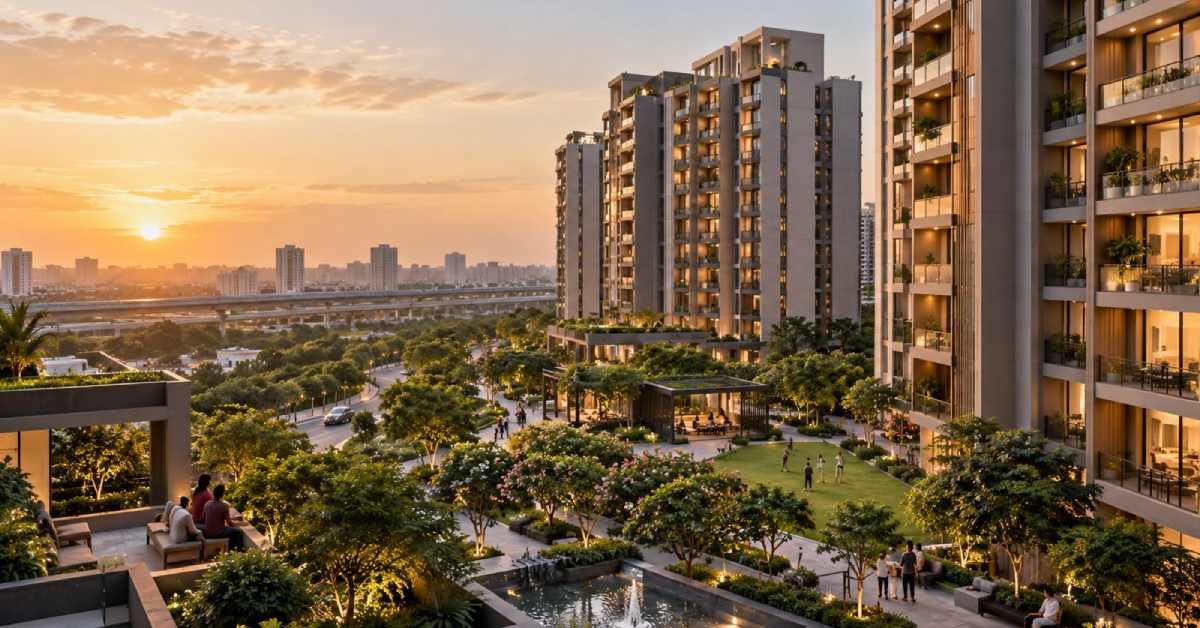
The feeling of wellbeing in a home extends beyond the walls of the home. Thoughtfully woven greenery, generous natural light and inviting outdoor spaces can create a more thoughtful rhythm to everyday life. This has expanded the definition of wellness in residential design, from one defined by dedicated amenities to the quality of the environment as a whole. Colliers’ outlook for 2026 finds increasing buyer interest in housing influenced by lifestyle and sustainability trends, including wellness-focused developments, greener homes and smart technologies.
This also changes the developer’s approach. Luxury cannot be created simply by adding another amenity, another tower or another layer of finish. It begins with understanding how people actually use a home, where they want privacy, where they spend time together, how much daylight enters a room, how easily technology works and whether the project enables people to unwind, spend time together and enjoy a more fulfilling everyday life.
The more interesting luxury home, therefore, may not be the one that has the most of everything. It is the one where every element is considered with purpose, from the first step inside to the quiet moments at the end of a long day. And perhaps that is the real direction in which luxury housing is headed: towards a more considered way of living, rather than simply more space.