

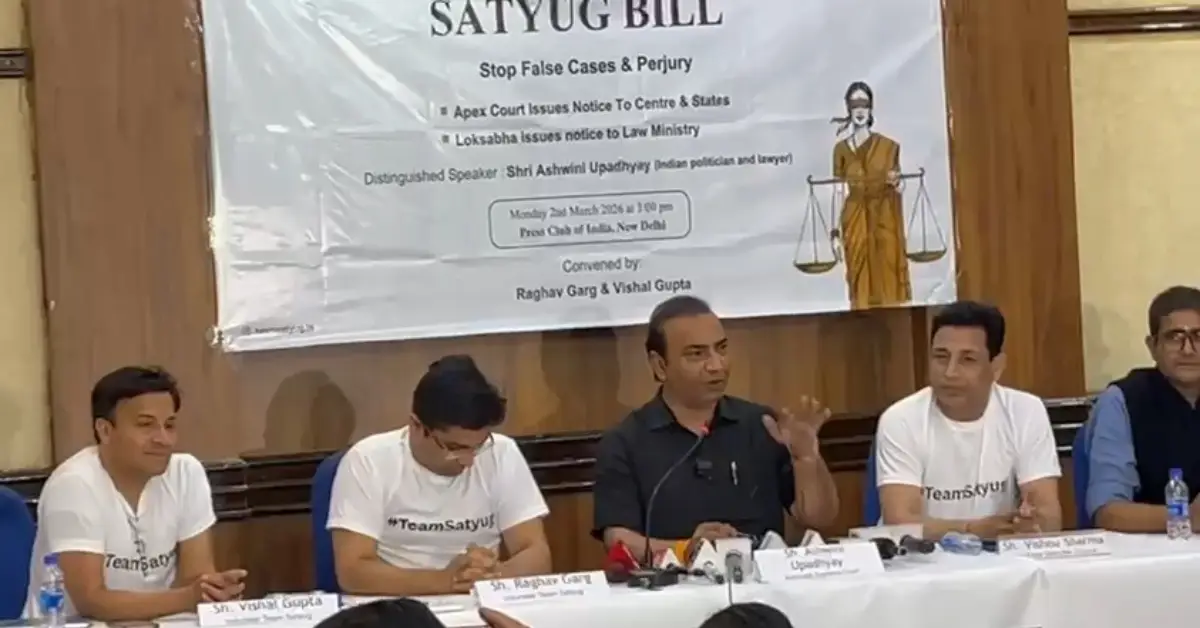
With nearly 5 crore cases pending across courts in India, legal experts have raised concerns that structural issues within the justice delivery system continue to contribute significantly to judicial delays. The issue was highlighted at a press conference held at the Press Club of India in Delhi, where speakers strongly advocated for the introduction of a proposed “Satyug Bill.” The proposed legislation seeks to restore the sanctity of sworn testimony and ensure stringent consequences for those who deliberately mislead the judicial system.
The experts emphasized that while increasing judicial appointments and digitizing courts are helpful, the real challenge lies in holding individuals accountable for false statements under oath. They argued that without strict action, court backlogs will persist. The issue has already been raised in Parliament and the Supreme Court. On 13 February 2026, false testimony and misleading pleadings were cited in the Lok Sabha as a major cause of case pendency. Subsequently, on 26 February 2026, the Supreme Court issued notice in a Public Interest Litigation seeking mandatory truth declarations, clear signage of penalties for perjury, and stricter enforcement of existing laws.
Speaking at the press conference, Raghav Garg of Team Satyug outlined five major recommendations aimed at reducing false litigation and judicial backlog.
“Under Sections 215 and 379 of the BNSS, if a complaint is found to be false, the judge is currently required to initiate proceedings personally as a complainant. This provision needs reform to simplify and strengthen enforcement. Data on offences related to ‘Obstruction of Justice’ should be made public quarterly, and cases involving false testimony or fabricated evidence must be separately recorded and fast-tracked. Additionally, India must increase its plea bargaining rate, which currently stands at just 0.11% compared to over 90% in many developed countries. A draft legislative proposal on this has already been submitted to the court and shared with the Law Minister. First, strengthen the law, then raise awareness; when the law is clear and stringent, systemic improvement will follow, and the number of undertrial prisoners can be reduced”, he said.
Petitioner and Advocate Ashwini Upadhyay stated that the primary reason behind mounting pendency is the lack of punishment for those filing false complaints, submitting fabricated documents, or giving false testimony.
“Those who file false complaints are not punished. Those who give false testimony are not punished. Those who submit false affidavits or fabricated evidence are not punished. Until amendments are made in the Bharatiya Nyaya Sanhita (BNS) and the BNSS, meaningful reform is not possible,” he said.
He further informed that he has filed a PIL in the Supreme Court against fake complaints and forged documents, including fraudulent Aadhaar cards, ration cards, birth certificates, wills, and residence certificates.
On the role of lawyers, Ashwini Upadhyay said, “Advocates neither have the time nor the resources to independently verify every factual claim made by clients. The system is such that the person filing the complaint submits facts through an affidavit. Lawyers cannot determine who is right or wrong; that responsibility lies with investigative agencies and the courts.”
The Satyug Bill aims to restore the sanctity of oath-taking and ensure swift, strict action against perjury, potentially reducing the massive court backlog. With both Parliament and the Supreme Court engaging on this issue, all eyes are on the government to implement concrete reforms.